

project brief
When a national auto parts retailer approached our Magento SEO agency, they were not short on products, ambition, or marketing budget.
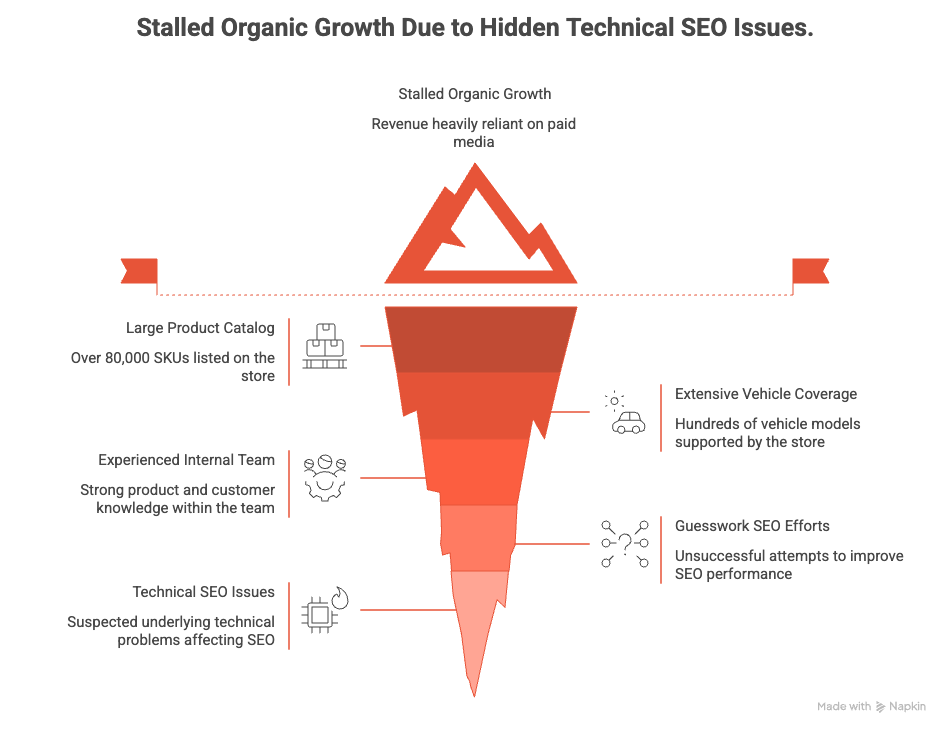
Their Magento 2 store listed more than 80,000 SKUs, covered hundreds of vehicle models, and had been live for several years.
Yet organic growth had stalled, and paid media was carrying most of the revenue load.
The internal team had a strong grasp of their products and customers, but every attempt they made to “do SEO” felt like guesswork and never moved the needle in a meaningful way.
They suspected there was a technical SEO issue but, like most ecommerce teams, they were too close to the day‑to‑day to see the full picture.
Results
The starting point: a huge catalogue on shaky foundations
Before any strategy was proposed, we ran a deep technical and content audit tailored to Magento’s peculiarities: layered navigation, faceted URLs, and auto‑generated parameter pages.
Crawl data, server logs, and analytics painted a consistent picture.
- Google was spending an enormous amount of crawl budget on parameterised and faceted URLs (brand filters, price sliders, fitment filters) that weren’t driving traffic or revenue.
- Important category pages like “brake pads”, “air filters”, and “exhaust systems” were either cannibalised by near‑duplicate URLs or being diluted across multiple weak variations.
- Product templates were heavy; JavaScript bloat and unoptimised images pushed core web vitals into the red on mobile, right where most of their customers were browsing.
- Out‑of‑stock and legacy products were still indexable, eating up crawl budget and occasionally outranking in‑stock replacements.
On the business side, the numbers explained the anxiety in the room:
- Organic traffic had flatlined for 12–18 months despite consistent publishing of new products.
- Non‑brand visibility in Google was weak; most organic traffic came from the brand name and a handful of legacy category terms the site had “always” ranked for.
- The paid team had begun to scale back ad spend because acquisition costs were rising, yet organic was nowhere near ready to pick up the slack.
- The team didn’t need “more content” in the abstract.
They needed their huge catalogue to be structured, crawlable, and understandable to search engines in a way that reflected how customers actually searched.
Positioning the project: technical first, but revenue‑led
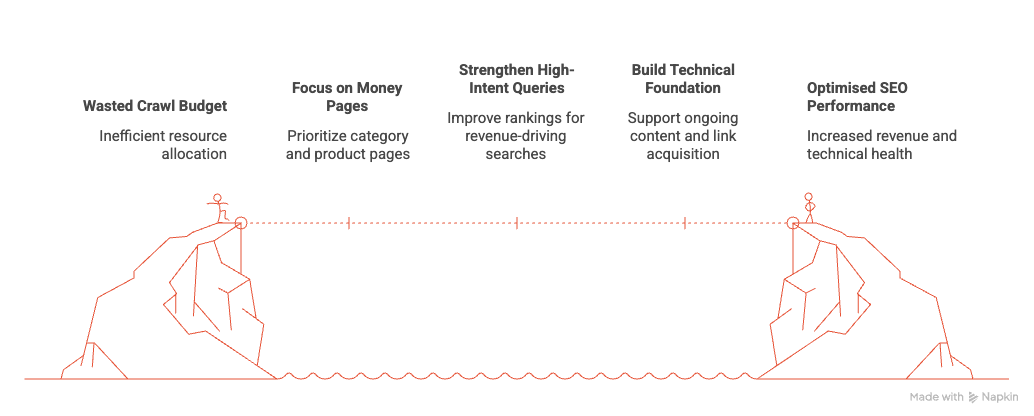
Rather than promising “more traffic” in the abstract, we framed the project around three outcomes:
- Reclaim wasted crawl budget and focus it on money pages (categories and key products).
- Strengthen rankings for high-intent category queries (“brake pads for [car model]”) that directly map to revenue.
- Build a technical foundation that would support ongoing content and link acquisition, instead of fighting against them.
We agreed on a clear measurement framework before making any changes:
- A defined list of priority categories and sub‑categories, with baseline rankings and traffic.
- Separate tracking for product‑level organic traffic and category‑level organic traffic.
- Explicit reporting on indexed URL counts, crawl stats, and key technical health metrics over time.
With this alignment in place, the project moved into implementation.
Phase 1: making sense of Magento’s URL jungle
The first phase was all about rationalising how Magento generated URLs and how search engines were allowed to interact with them.
We mapped out every URL pattern the site produced:
- Clean category URLs.
- Category + filter combinations (brand, price, model, engine size).
- Pagination, sort order, and view toggles.
- Internal search results pages.
From here, we designed a clear, opinionated set of rules:
- Primary category URLs would be the only versions allowed to be indexed and to rank.
- Faceted and parameterised URLs would be treated as supportive UX tools, not standalone landing pages competing in search.
- Pagination would be handled with consistent canonicals back to page one for most collections, with exceptions for carefully chosen long lists where deeper pages had unique demand.
Working closely with the development team, we implemented:
- Canonical tags at the theme level for category and product templates, ensuring all filter and sort variants pointed back to the canonical parent.
- Meta robots rules and robots.txt updates to prevent crawling of low‑value parameter URLs, internal search pages, and known crawl traps.
- Clear handling for out‑of‑stock products: either redirecting to the closest in‑stock equivalent, or placing them behind noindex where appropriate.
Almost immediately after rollout, we saw a steady decline in the number of low‑value URLs being crawled and indexed.
For the first time, Google could spend a meaningful proportion of its crawl budget on the pages that actually mattered.
Phase 2: fixing performance where it impacts money
Technical clean‑up was only one piece of the puzzle; the store also had to feel fast and responsive, especially on mobile.
We focused on the templates that generated the most revenue:
The main category templates for top‑selling parts.
Product templates for core SKUs in each major category.
Working with the client’s developers, we prioritised:
- Image optimisation: compressing and serving images in modern formats, redefining dimensions, and fixing lazy‑loading behaviour that was breaking LCP on critical elements.
- JS and CSS optimisation: deferring non‑critical scripts, reducing unused CSS, and re‑ordering the loading sequence so that above‑the‑fold content rendered quickly.
- Server‑level improvements: better caching policies and more efficient handling of repeated requests to popular category pages
Rather than chasing a perfect Lighthouse score for every minor page type, we concentrated on ensuring that the pages users and search engines hit most would perform well and consistently.
This kept the development backlog focused and aligned with business reality.
Phase 3: rewriting the store’s internal narrative
With a cleaner, faster, more focused site, we turned to on‑page optimisation and internal linking.
The original category pages had thin or generic content.
Titles were often just the category name, descriptions were a line or two of boilerplate text, and there was little to differentiate each page in the eyes of a search engine.
We worked through the site’s category hierarchy and:
- Re‑wrote titles and H1s to reflect how real users search: combining part type, vehicle context, and key modifiers (e.g. performance, OEM, aftermarket).
- Expanded category descriptions to clarify the product range, fitment details, and key benefits without turning the pages into blog posts.
- Introduced structured “buying guide” and FAQ sections for high‑value categories, using markup where appropriate to target rich results.
At the same time, we redesigned internal linking so that:
- Priority categories linked to related sub‑categories and buying guides, forming tightly themed clusters.
- Product pages linked back to their parent categories and related products in a way that reinforced topical relevance rather than scattering links everywhere.
Slowly, the site became less of a flat product catalogue and more of a structured, interlinked knowledge base about auto parts, built entirely on top of Magento’s existing capabilities.
Phase 4: monitoring, iteration, and compounding gains
Instead of treating the project as a one‑and‑done “SEO fix”, we established a cadence of monthly and quarterly reviews.
Each month we tracked:
- Indexed URL count, segmented by type (categories, products, parameters).
- Crawl stats, with particular focus on how often Googlebot was visiting key categories and products.
- Ranking and traffic changes for the agreed set of high‑intent queries.
Every quarter, we:
- Identified new categories and sub‑categories that warranted their own optimised landing pages based on search data and sales trends.
- Refined internal linking structures to push more authority into emerging product lines.
- Tested incremental improvements to templates, messaging, and content layouts.
- This iterative approach allowed we to keep building on the technical foundation rather than constantly firefighting new issues.
The results: what changed for the business
Over the course of the first 3–6 months, the impact became clear.
On the technical side:
- The number of indexed URLs dropped significantly, but traffic did not; instead, it became more concentrated on important category and product pages.
- Crawl stats showed that Googlebot spent less time on low‑value URLs and more on money pages, especially after each iteration of our rules and canonicals.
On the commercial side:
- Organic traffic to category pages grew substantially, with many priority terms moving from page 2 or lower into the top 5.
- Product‑level organic sessions increased as more long‑tail, fitment‑specific queries found the correct pages.
- Organic revenue grew meaningfully, taking pressure off paid channels and giving the client confidence to reinvest in content and PR.
The client’s internal narrative also changed.
Instead of seeing Magento as a “black box” that limited their SEO potential, they began to understand it as a powerful, flexible platform that simply needed the right strategy and configuration.
clear approach
UI UX Design & Guidelines

project outcome
UI UX Design & Guidelines